

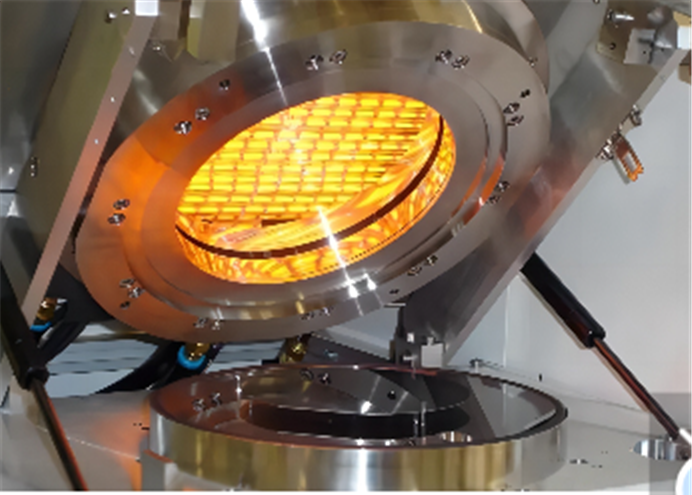
On the line, flexible electronics wafers don’t forgive thermal excursions. A soft bake that drifts even a little throws off critical dimensions in the next lithography steps. A hard bake that runs hotter than it should can crack thin-film layers or kick off stress migration. The fallout is scrap, rework, and yield loss that compounds across the lot. What matters under the hood We built the heater around short-wave infrared, so you get sub-millimeter thermal uniformity across the substrate. During photoresist bake, it holds wafer-level temperature control to ±0.1°C, and the repeatability stays inside the thermal budget of delicate polyimide and ultra-thin carrier stacks. Infrared energy drives straight into the photoresist, cutting thermal lag and letting you ramp fast without overshoot. The platform is cleanroom-ready for Class 1–100, with materials and surfaces chosen to keep particle counts down. And “zero particle generation” isn’t a tagline—we measure it against metrology thresholds inside the real process window. Here’s why it sticks in flexible electronics: you need heat in the resist, not bleeding into the tool. This heater locks down the bake profile for both soft bake and hard bake, so line-width control and adhesion stay consistent wafer to wafer. Tight uniformity cuts edge-bead anomalies and trims the need for extra trimming exposures. You use less energy because the infrared source heats only the target, not the chamber around it. Reliability comes from components rated for 24/7 cadence, with documented uptime in production where unplanned downtime translates straight to missed lots. A few practical notes. The heater plugs into standard semiconductor equipment interfaces, but it needs its own dedicated electrical circuit and clean dry air supply to keep infrared output and cooling stable. Plan a short commissioning window to dial the thermal profile to your resist stack and substrate thickness. Once calibrated, it holds setpoint with minimal drift—even when you swap carriers.
ライン上のフレキシブルエレクトロニクスウェハは熱的な変動を許容しない。ソフトベークの温度がわずかにずれるだけで、次工程のリソグラフィーにおける重要寸法がずれてしまう。ハードベークで指定より高温になると、薄膜層にクラックが入り、応力移動を誘発する可能性がある。その結果として、スクラップ、不良手直し、歩留まり低下が生じ、ロット全体に累積する。
内部で重要なポイント
本ヒーターは短波赤外線を中心に設計されており、基板全体でサブミリメートル単位の熱均一性を実現する。フォトレジストのベーク中、ウェハレベルで±0.1°Cの温度制御を維持し、繊細なポリイミドや極薄キャリアスタックの熱許容量内で再現性を保つ。赤外線エネルギーはフォトレジストに直接浸透し、熱遅れを削減、オーバーシュートなく高速な温度上昇を可能にする。プラットフォームはクリーンルーム対応でClass 1–100相当、材料と表面処理は粒子発生を抑制するものが選定されている。また「ゼロ粒子発生」は単なる謳い文句ではなく、実際の工程ウィンドウ内で計測器の閾値と比較し確認している。
フレキシブルエレクトロニクスで採用される理由は明確で、加熱すべきはレジスト内であり、装置本体に熱が流出してはならない。ソフトベークとハードベークの両方でベークプロファイルを確実に保持するため、ウェハ間でライン幅制御と密着性が安定する。厳密な温度均一性はエッジビード異常を減らし、余分なトリミング露光の必要性を削減する。赤外線源が対象部分のみを加熱するため、周囲のチャンバーは加熱せず省エネルギー効果がある。信頼性は24時間365日稼働に対応した部品を用いており、不意の停止がそのままロットの逸失につながる実生産現場での稼働率実績も文書化されている。
実用上の注意点をいくつか挙げる。
本ヒーターは標準的な半導体装置インターフェースに接続可能だが、赤外線出力と冷却の安定化のため、専用の電気回路と清浄な乾燥空気供給が必要。レジストスタックおよび基板厚みに合わせた熱プロファイル調整のため、短時間の立ち上げ調整時間を見込むこと。キャリア交換時も設定温度を最小限のドリフトで維持できる。